
Cole County Scheduled Versus Actual Release
A scheduled or minimum date is a calculation. An actual release date records a custody event that has occurred. The two may match, but they answer different questions. MODOC can calculate sentence dates while authority continues. A jail or prison release entry records the physical exit or transfer. Final discharge is later when parole, conditional release, or other department authority ends.
A pretrial detainee usually has no sentence-release date because bond, court orders, and holds control the outcome. A sentenced county inmate may have a definite term, but no verified public Cole County good-time or weekend-shift formula was found. A Missouri state prisoner can have minimum and maximum sentence fields without a guaranteed day to leave the institution.
| Date or event | Meaning | Best source |
|---|---|---|
| Bond or release order | Legal authority that may permit exit | Case.net and court record |
| Sentence-I Minimum Release Date | Calculated minimum on an active sentence | MODOC historical data |
| Sentence Maximum Release Date | Maximum release or expiration field | MODOC historical data |
| Actual release or transfer | Recorded physical custody event | Jail, prison, or receiving agency |
| Final discharge | End of MODOC legal authority | MODOC historical or discharge record |
Find Cole County Projected Release Dates
Start by identifying whether the person is at the Cole County Detention Center, ACC, JCCC, another state institution, or a federal facility. The county current roster can show a live booking, but it does not publish a release date. State-prison and active community-supervision questions belong in the MODOC Offender Web Search. Federal dates require BOP records, while a USMS pretrial detainee may not appear in BOP's public locator.
- Match the person to a booking number, court case number, MODOC number, or federal register number.
- For county custody, read Case.net for bond, sentence, and release orders, then call the jail.
- For Missouri prison custody, search MODOC and copy every date exactly as labeled.
- Compare the sentence, court case, parole status, and any consecutive term or detainer.
- After the expected date, confirm the actual release or transfer with the holding agency.
- After final discharge, use the MODOC historical file or a focused records request.
The broader Cole County release-record search shows how to reconcile the county, court, state, federal, and receiving-agency systems when custody type is uncertain.
Cole County MODOC Release Fields
Missouri's official historical offender-data dictionary supplies two exact labels: “Sentence-I Minimum Release Date” and “Sentence Maximum Release Date.” It also includes a Completed Flag, sentencing date, sentence length, court and case number, county codes, offense description, and probation information. One person can have several rows because the file stores a record for each charge. Those rows must be read together.
The minimum is a calculated minimum date on an active sentence. The maximum is the sentence maximum release or expiration date. Special sentinel values can represent life, indeterminate or interstate cases, and assessment circumstances. The live offender search is CAPTCHA-protected, and its post-CAPTCHA date label was not verified in research. Do not rename a live field “projected release date” unless the actual result uses that label.
The official MODOC field definitions document the sentence-date fields used for this Cole County inquiry.
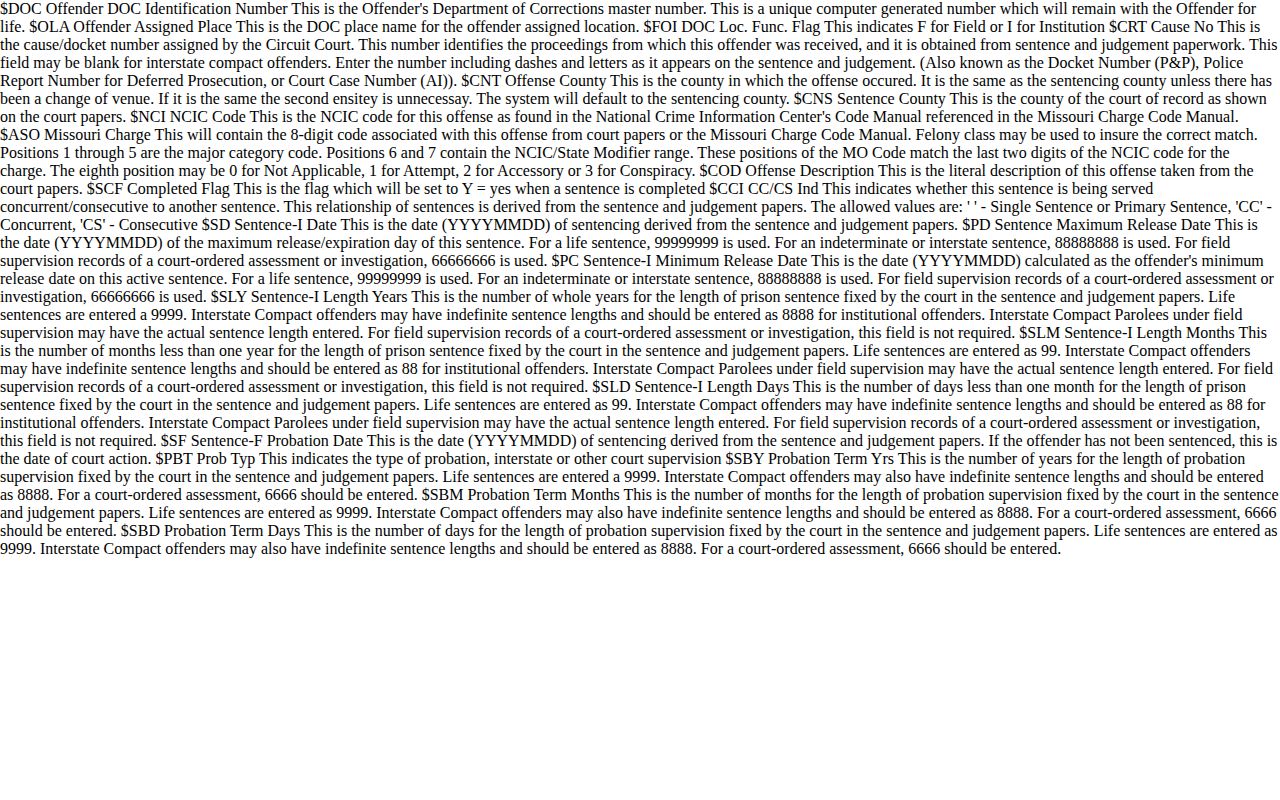
The image supports the safe minimum, maximum, completion, and sentence labels without promising a future physical exit.
Note: MODOC minimum and maximum fields must retain their official labels because neither field alone proves a scheduled or actual release.
Cole County Conditional Release Calculations
RSMo § 558.011 divides eligible term-of-years felony sentences into prison and conditional-release terms. For a term of nine years or less, the conditional-release term is one-third. For more than nine through fifteen years, it is three years. For more than fifteen years, it is five years. The prison term is the remainder. Dangerous felonies and certain repeat remands are treated differently, and the Board can extend the prison term.
This arithmetic applies to eligible MODOC sentences. It is not a formula for every stay in the Cole County Detention Center. Conditional release also does not mean final discharge. A person leaves prison confinement but remains in MODOC legal custody and under Division of Probation and Parole supervision. The sentence record, Board action, and current status must be read together.
Note: A conditional-release term is part of a state sentence, not a public promise of a specific Cole County jail exit time.
Cole County Minimum Prison Terms
RSMo § 558.019 sets a minimum prison term for a dangerous-felony offender committed to MODOC. The person must serve 85 percent of the court sentence or reach age seventy after serving at least forty percent, whichever occurs first. For the statute's calculation, life is treated as thirty years and an aggregate above seventy-five years as seventy-five years.
“Minimum prison term” concerns eligibility for parole, conditional release, or another early MODOC release. Eligibility is not release. It does not override a separate sentence, detainer, Board decision, or later court order. Because the rule is offense and sentence specific, the judgment and statute must be matched to the exact case rather than applied from a charge label alone.
The official minimum-prison-term source is shown below.
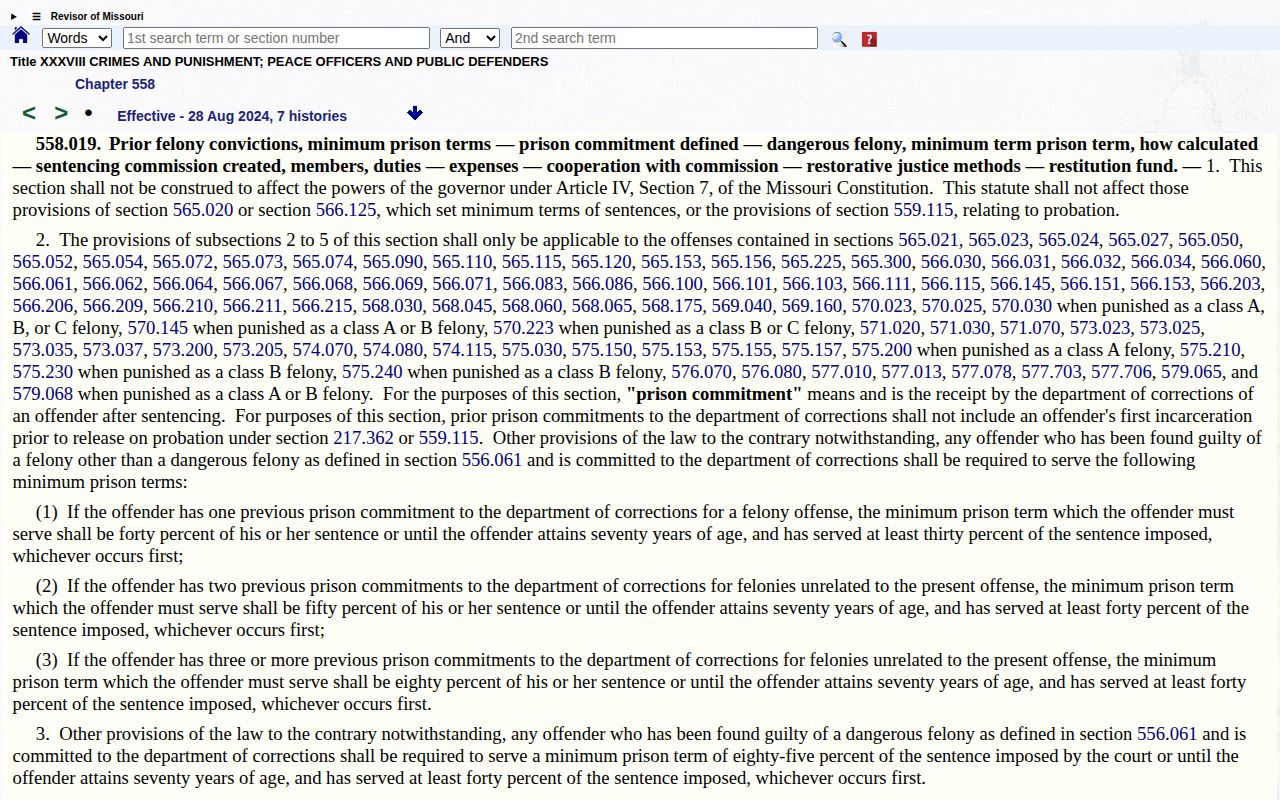
The statute sets an eligibility floor for covered cases, while MODOC and the Board control the case-specific record.
Cole County Parole Release Dates
RSMo § 217.690 requires a Missouri Parole Board order for parole. Parole is not clemency, a sentence reduction, or a pardon. The person remains in MODOC legal custody after leaving prison. Board guidelines and a hearing can shape a future date, but neither guarantees release.
Institutional adjustment, conduct, programs, risk review, and the release plan may affect Board action. A hearing may result in a future release date or another hearing in one to five years, and decisions ordinarily take about eight to twelve weeks. Specific release-date and home-plan questions go to the institutional parole office. Community reporting questions go to the assigned field office.
Final discharge is distinct. RSMo § 217.730 permits final discharge after satisfactory parole or conditional release under its terms. The prison exit date and discharge date must never be merged.
Cole County Release Date Changes
Several events can move the practical date. A court may amend the judgment. Concurrent sentences run together, while consecutive sentences run in sequence. Disciplinary action and credit calculations can alter state computations. The Parole Board may grant, deny, defer, or revise a release path. A detainer gives another agency a claim to take custody, so the person may leave one institution only to enter another.
| Change | Effect on the date | Record to check |
|---|---|---|
| Amended judgment | Changes sentence terms or credit | Case.net and commitment record |
| Consecutive sentence | Adds a term after another | MODOC charge rows and judgment |
| Discipline or credit review | Can alter a calculation | MODOC case and sentence record |
| Parole Board action | May set, defer, or deny release | Board and institutional record |
| Detainer or warrant | Can stop release or cause transfer | Holding and receiving agencies |
| Revocation | Can return a supervised person to custody | MODOC and court or Board record |
A Cole County VINELink notification can flag a custody event, but the originating agency must confirm whether it was release, transfer, or another status change.
Publication timing adds another source of change. The MODOC historical file updates nightly, while a same-day court order, hold, or release may not yet have reached every public system. The active search also excludes discharged offenders, so a missing result after a known sentence does not prove that the calculated date was met. Use the historical file and request the actual release and discharge records.
Cole County Jail Release Calculations
A pretrial Cole County detainee has no fixed sentence-release date. Bond, a recognizance order, dismissal, case disposition, and outstanding holds control the path. Even after bond is posted or one judge orders release, another warrant, detainer, sentence, municipal matter, federal hold, or immigration action can keep the person in custody. The jail's physical release or transfer record provides the actual event.
A county-sentenced person may have a definite term and credit for time served, but no verified public Cole County good-time formula was found. Research also found no supported weekend-release shift rule. Ask the jail and court for the existing calculation and release entry. The current county portal supplies booking facts but no release-date or release-reason field.
- Time served
- Custody time credited or a sentence completed as the court records it.
- Detainer
- A request or authority from another agency that may block community release.
- Minimum date
- A calculated eligibility point, not a guaranteed exit.
- Actual release
- The recorded physical exit or transfer event.
Cole County Last-Minute Warrant Checks
Cole County detention staff run an active-warrant check immediately before release. That local step explains why an expected exit based on bond, time served, or a court order can change at the last moment. A newly found warrant can preserve custody or lead to pickup by another agency. The expected date was not necessarily calculated incorrectly; a separate source of authority intervened.
This is the supported local release-date quirk. No public county good-time or weekend formula was verified, so one should not be invented. Call the jail about the named booking, inspect Case.net for each known matter, and ask the release record whether the event was delayed, canceled, or converted into a transfer. The receiving agency should confirm what happened next.
A receiving-agency record is the next check when the warrant leads to transfer. A MODOC intake confirms state custody, BOP can confirm many federal prisoners, and ICE has a separate detainee locator. USMS pretrial movement may require federal court or direct agency records because there is no equivalent public historical person locator. None of those events should be reported as release to the community.
Note: The actual jail release entry controls the physical event even when an earlier court or sentence record suggested a likely date.