
Cole County Parole Versus Probation
Probation is a court disposition. It usually allows a person to live in the community under stated terms instead of serving all or part of a prison sentence. Parole is a release from prison ordered by the Missouri Parole Board before the sentence fully expires. Conditional release is another prison-to-community status created by Missouri law. Both parole and conditional release stay under the Missouri Department of Corrections, Division of Probation and Parole. None is the same as final discharge.
The distinction controls where to verify the record. A Cole County probation case should be compared with the judgment and docket in Missouri Case.net. A parole or conditional-release status begins with the MODOC offender record and the Board or institutional record. The live state search can also show active probationers. It is not a list of every person who once served a sentence.
| Status | Who orders it | Best verification |
|---|---|---|
| Probation | Court | Case.net judgment, active MODOC record, District 27 |
| Parole | Missouri Parole Board | MODOC active record, Board or field office |
| Conditional release | Missouri sentence law and MODOC | MODOC status and sentence records |
| Final discharge | Court, Board, or sentence completion | MODOC historical file or records response |
Verify Cole County Post-Release Supervision
The MODOC Offender Web Search is the first public route for active state authority. It covers people in prison and people on probation, parole, or conditional release. The landing page expressly excludes discharged offenders. Use a MODOC number when known because names and aliases can produce uncertain matches. Copy the exact status, office, location, sentence, and date labels instead of turning them into broader claims.
- Search by MODOC number or permitted name fields, then compare the identifying details.
- Read whether the record indicates prison, probation, parole, or conditional release.
- Identify District 27 or the institutional office shown and call that office for routing.
- Compare probation with the Cole County court judgment, or parole with the Board process.
- If the live search has no record, check the nightly historical file and request the discharge record.
Cole County Supervision at District 27
District 27-Jefferson City is the ordinary field office for Cole County community supervision. The current MODOC address listing places it at 3411B Knipp Drive. An older official locator still points to West Main Street, so the current listing should control and a caller should confirm the destination before traveling. District 26 is the Fulton Community Supervision Center in Callaway County. It can matter for a residential placement, but it is not Cole County's default field office.
District 27-Jefferson City3411B Knipp Drive
Jefferson City, MO 65109
573-751-4949
The current District 27 listing shows the local office used to route active supervision questions. The image below records that official source, while the phone call remains important because an assigned officer or office can change.
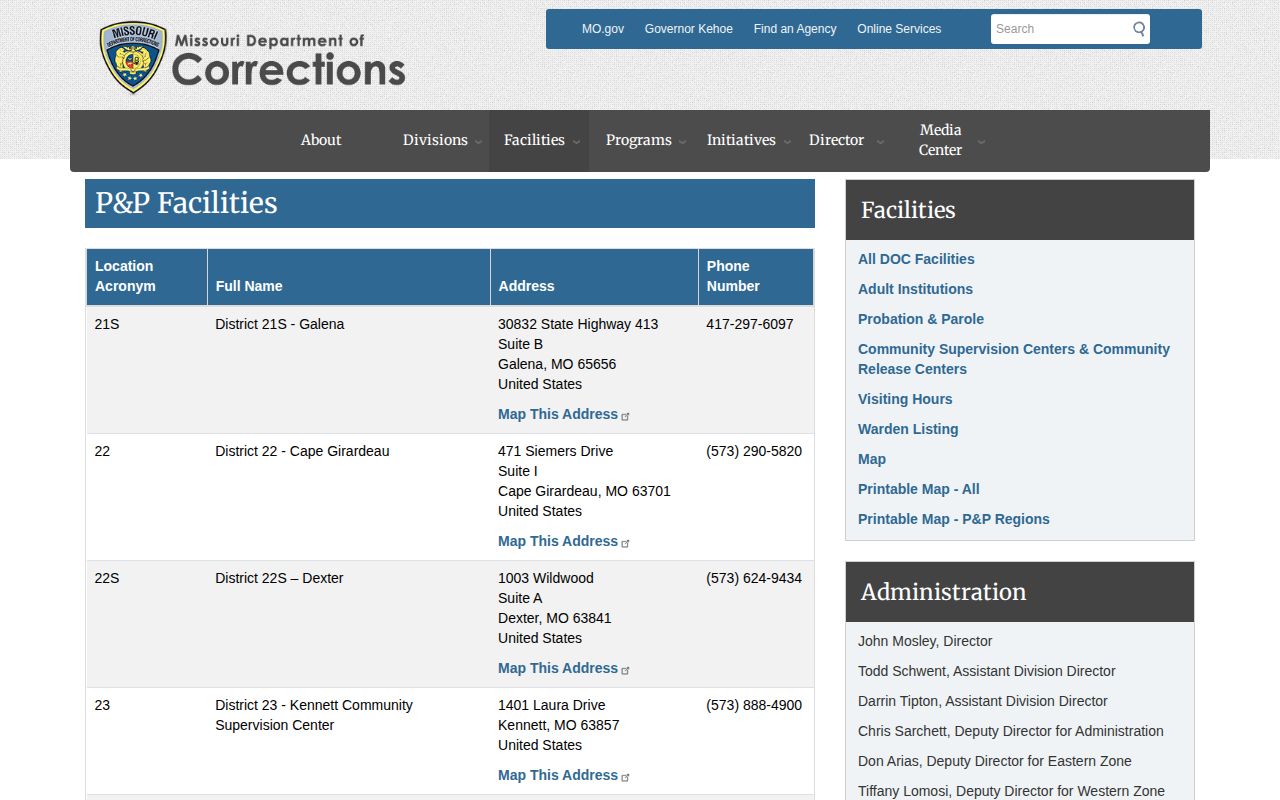
Use the office shown on the person's active MODOC record when it differs from the ordinary Cole County district.
Cole County Parole Office Routing
Jefferson City contains both community and institutional parole functions. Algoa Correctional Center and Jefferson City Correctional Center use institutional staff to develop a release plan before prison exit. Once a person enters the community, the supervising field officer and district become the more useful contacts. Asking only for “the Jefferson City parole office” can reach the wrong part of the process.
For statewide routing, the Division of Probation and Parole is at 230 Metro Drive, Jefferson City, MO 65109, telephone 573-526-3231, and email Probation.Parole@doc.mo.gov. The Missouri Parole Board is at 3400 Knipp Drive, Jefferson City, MO 65109, telephone 573-751-8488, and email DOC.MissouriParoleBoard@doc.mo.gov. These state contacts do not hold Cole County Jail release records.
Note: Call the office listed on the active MODOC record before visiting, especially when older state pages show a conflicting address.
Cole County Supervision Warrant Checks
A warrant, absconder notation, violation, or revocation is a separate fact. An absconder is a supervised person whose whereabouts are unknown or who has failed to remain in contact as required. Missouri's Command Center operates at all hours for electronic monitoring and community residential assignments, investigates serious violations, and coordinates when warrants issue. Research found no public statewide MODOC absconder database.
Cole County has a separate warrant name search. It may show an unresolved enforcement entry, but it cannot prove present jail custody, active parole, or a past release date. Check the current county roster for jail custody, the MODOC record for state supervision, and the issuing court or agency for the warrant. One source should not be made to answer all three questions.
Note: A Cole County warrant result is an enforcement lead, not proof of current custody, active supervision, revocation, or release.
Cole County Supervision Discharge Records
Community supervision may end through expiration, court action, Parole Board discharge, or an authorized early-discharge process. MODOC explains that eligible, compliant people can earn thirty days of supervision reduction for each full qualifying calendar month. Under RSMo § 217.703, a month involving custody, a violation, or absconder status does not qualify, and other eligibility rules apply. Earned compliance credit reduces community supervision. It is not prison good time and cannot calculate a jail release date.
Once final discharge occurs, the active offender search may no longer return the person. The MODOC Sunshine historical offender file is the official fallback. It is updated nightly and covers people who are or have been under department authority, with records reaching as early as 1974. A focused request may also seek the supervision start and end, discharge certificate or order, and the authority for the change.
- Parole
- Board-ordered prison release while the sentence and MODOC authority continue.
- Probation
- Court-ordered community supervision tied to a judgment.
- Absconder
- A supervised person reported out of contact or whereabouts unknown.
- Final discharge
- The end of the sentence or supervision authority, not merely prison exit.
Cole County Parole Hearing Records
The Missouri Parole Board publishes rules, guidelines, and contacts. Its guidelines do not promise release. The official hearing process says scheduling depends on sentence length, and a hearing may lead to a future release date or another hearing in one to five years. The Board reviews institutional conduct, adjustment, programs, and other case material. Decisions ordinarily take about eight to twelve weeks.
No official public statewide hearing calendar or name-searchable decision portal was found. For a named person, use the active offender record, institutional parole staff, the Board, and Victim Services as access allows. MOVANS can send eligible registrants notice of hearings and decisions. A hearing date and a Board decision still do not equal final discharge.
The Board process and the supervision record should be reconciled. RSMo § 217.690 requires a Board order for parole and makes clear that parole is not clemency, a sentence reduction, or a pardon. Sentence-specific minimum terms can also control when the person becomes eligible. Eligibility, a hearing, and a favorable decision each precede the physical exit record. After release, the active MODOC status and assigned district show that legal custody continues in the community.
Note: A future Board date is a process event, not proof that a person left an institution or completed a sentence.
Cole County Release Reentry Services
MODOC Reentry Services is based at 1717 Industrial Drive, Jefferson City, MO 65109. It coordinates reentry centers inside state prisons and community follow-up. That local presence is relevant to a person leaving ACC, JCCC, or another Missouri prison. It does not handle an ordinary bond release from the Cole County Detention Center, and it does not replace the field office that verifies active supervision.
The custody path should stay clear. Prison release planning begins through the institution and MODOC. Community reporting moves to the assigned probation and parole district. A county bond-out remains tied to the jail, court, and any pretrial terms. The broader Cole County released-inmate search and record path identifies the correct source when the starting custody system is uncertain.
Cole County Release Property Deadlines
The Cole County inmate handbook adds a practical issue after a jail release. Personal property is returned, and account funds move through a debit-card process. A former inmate has five business days to report to the Jail Clerk; after that, funds are mailed to the booking address. A property-release form can authorize pickup. The handbook also warns that unclaimed property may be treated as abandoned after thirty days.
Transfers use different rules. USMS and MODOC movements can change how property is handled, and the handbook includes a five-day transfer pickup period alongside the broader thirty-day disposal rule. These deadlines concern property from the county jail. They do not prove parole, probation, or discharge status, but they can explain why the former detainee or an authorized person must contact the Jail Clerk soon after the custody event.
A county property transaction should not be used as a substitute for a supervision record. A person may retrieve funds or property after a county-jail event without ever entering MODOC parole, while a person released from ACC or JCCC follows state institutional procedures. Match the property source to the facility, then verify probation through the court and parole through MODOC.