
Michael Prenger Confidential Records
Confidentiality is the starting rule for this secure juvenile unit. Missouri Revised Statutes § 211.321 restricts juvenile records subject to statutory exceptions. That means public-access assumptions cannot be carried into a Michael Prenger Family Center inquiry. A person's name, detention status, allegation, hearing information, photograph, placement, or release date may not be available to a member of the public.
An authorized parent, guardian, attorney, court participant, or agency should use the Juvenile Division's own process. The relationship to the youth and the reason for the request matter because the court must protect confidential case information. A caller should be ready to identify themselves and the case connection without sharing private youth information through an unofficial channel.
Michael Prenger Detention Records
The Cole County Juvenile Detention page identifies the Michael Prenger Family Center's secure detention function. Cole County reports that the unit has three beds and serves youth ages 12 through 17. It operates through the Cole County Juvenile Court and 19th Circuit, not through the Sheriff's adult jail roster.
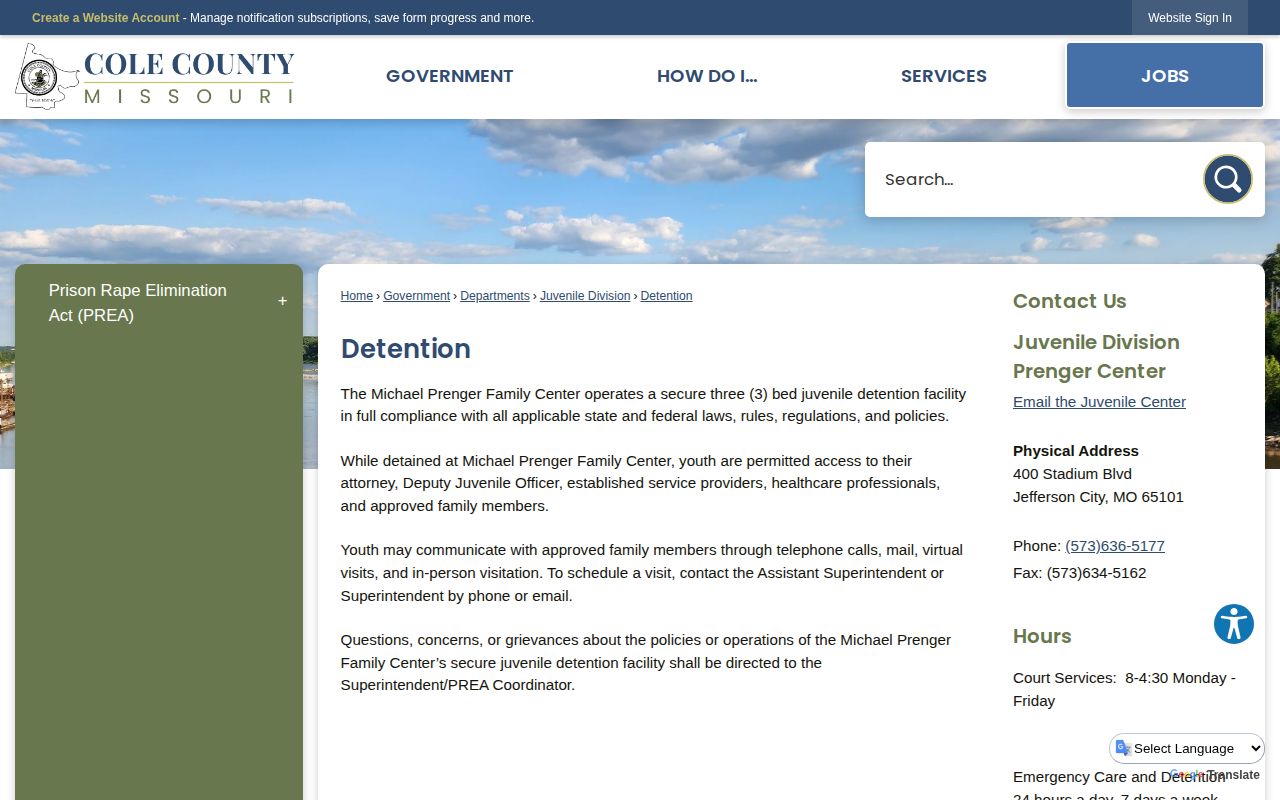
The official facility capture documents the local juvenile source. It should be used for contact and program context, not as evidence that a named youth is detained or released.
Secure detention operates continuously, while Court Services office hours are Monday through Friday from 8:00 a.m. to 4:30 p.m. That difference matters. Continuous operation does not mean that public case-record staff or an authorized case contact is available at every hour. Urgent case questions should follow the directions already given to the authorized family member, attorney, or participant.
Michael Prenger Release Confirmation
A Michael Prenger release is a juvenile court matter. The reliable confirmation comes from the Juvenile Division, court, facility, or an authorized representative involved in the case. The court's order and the facility's action must be read together. A court decision may direct release, transfer, return to an authorized custodian, or another placement, but the public should not be given an unsupported description of where a youth went.
Use the exact language supplied through the authorized channel. “Released from secure detention” identifies the custody that ended. It does not by itself state that all court oversight ended or that the youth returned to a particular address. A placement change can also end detention at this unit without making the destination public.
- Contact the Juvenile Division using the official facility information and identify the authorized relationship to the youth or case.
- Provide the court case number or other identifier requested by staff. Avoid sending private details through public forms not designated for juvenile matters.
- Ask whether the court or facility can confirm the detention status, release event, or placement information to that authorized role.
- Request the proper procedure for a copy of any record the authorized person may receive, including required identification or court approval.
- Preserve the terms used by the court or facility. Do not relabel a transfer or placement as an unrestricted community release.
Note: A public silence or refusal to confirm is consistent with confidentiality and does not prove either current detention or release.
Michael Prenger Records Contact
The Michael Prenger Family Center is at 400 Stadium Boulevard in Jefferson City, Missouri. The published telephone number is 573-636-5177. Court Services lists office hours from 8:00 a.m. to 4:30 p.m., Monday through Friday, while detention functions continue around the clock.
Michael Prenger Family Center
Secure Juvenile Detention Unit
400 Stadium Boulevard
Jefferson City, MO 65101
573-636-5177
Court Services: Monday-Friday, 8:00 a.m.-4:30 p.m.
Call before visiting for a records or case question. Staff can explain the correct authorized route but may be unable to confirm that a named youth is present. Do not arrive expecting a public booking desk, roster printout, or open release log. The facility's security and the youth's privacy control what can be discussed.
For court-file routing, use the Juvenile Division instructions provided for the case. The Cole County Circuit Court's general criminal division is not a substitute for juvenile access rules. An attorney or authorized case participant may need to follow a court-specific process that cannot be replaced by a general county records request.
Note: Court Services has weekday office hours even though secure detention operates continuously, so call before seeking an authorized record.
Cole County Juvenile Record Law
Section 211.321 is the controlling research source for confidentiality. The official statute page below is matched to this facility because it establishes why a public release-search workflow is not appropriate. It should be read in its current form for the exceptions and access rules that may apply to a particular role.
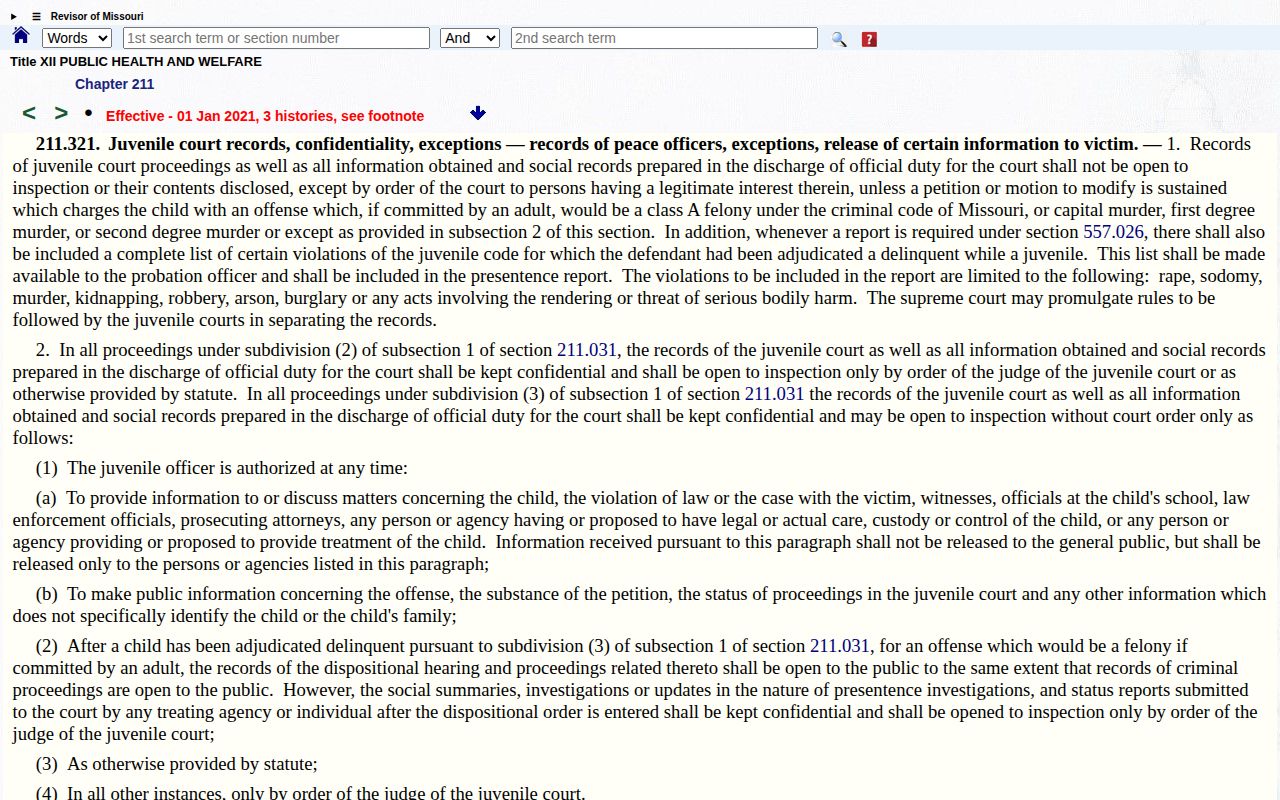
The statute capture supports the confidential court route. It does not authorize publication of a youth's name, photo, case allegations, detention dates, or release destination.
Missouri's general open-records rules do not erase the special protection for juvenile material. A request to a county custodian can still be withheld or redirected when juvenile law controls. If the requester has an authorized role, the better question is not whether the public can see the record. It is what the Juvenile Division requires from that role to obtain the allowed confirmation or document.
An access decision may also depend on the exact record. A court order, facility log, case file, and placement communication are different records with different custodians and confidentiality concerns. Ask the court or facility to identify the proper custodian rather than sending the same broad request to unrelated offices.
Michael Prenger Public Record Limits
No public roster, recent-release feed, booking-photo gallery, charge-card view, or projected release calendar was identified for Michael Prenger Family Center. Those absences reflect the confidential juvenile framework. They should not be filled with information from the county adult portal, Case.net criminal search, MODOC offender search, VINELink, MobilePatrol, or commercial sources.
| Information sought | Proper route | Public assumption to avoid |
|---|---|---|
| Whether a youth is detained | Juvenile Division or facility through an authorized role | That a public name search should exist |
| Release or transfer confirmation | Court or facility case channel | That absence from another system proves release |
| Case record or order | Juvenile court access process | That an adult criminal docket supplies it |
| Photograph | Only an authorized juvenile record route if permitted | That a public booking photo is available |
| Placement destination | Authorized court or agency communication | That it should be publicly disclosed |
Public-search tools are not harmless substitutes. They can produce a false match to an adult or unrelated case, expose private youth information, or imply an event that the juvenile court has not confirmed. The correct result may simply be that the agency cannot disclose the information to the requester.
Note: A refusal to disclose a juvenile record does not establish whether a youth remains detained, was released, or entered another placement.
Michael Prenger Release Terms
Precise wording protects both accuracy and privacy. “Detention” means secure custody in the juvenile unit. “Release” means that custody at that unit ended, but it does not define all court obligations. “Transfer” means movement to another custodian or placement. “Placement” can describe a court-directed setting after detention. The authorized source should supply the term that applies.
- Authorized person
- A person or agency whose role permits contact or access under the court's process and applicable law.
- Juvenile record
- A record connected to a youth matter and governed by juvenile confidentiality rules.
- Release
- The end of the secure detention being discussed, with any next status stated separately.
- Placement
- A court or agency-directed setting that may follow detention without being a public destination.
- Transfer
- Movement to another authorized custodian or setting rather than an unrestricted exit.
Do not ask staff to translate a confidential status for a public audience. An authorized person can request clarification of an order or instruction through the case channel. A public requester should accept that the facility may give no named-person response.
Cole County Juvenile Release Coordination
Release planning for a youth is tied to the juvenile case, not to the county adult jail's release categories. The facility, Juvenile Division, court, authorized custodian, attorney, and other approved participants may each hold part of the information. The correct point of contact depends on whether the question concerns physical detention, a court order, a placement instruction, or a document request.
For physical status, begin with the facility through the authorized relationship. For the meaning of a court order or the next hearing, use the Juvenile Division or attorney. For a copy of an allowed record, ask which office is its custodian and what proof of authority is required. These routes keep the request within the confidential case process.
Never publish private details received because of a family, legal, or agency role without confirming the governing restrictions. A record that may be shared with an authorized person does not become a public record for all purposes. The safest account of a Michael Prenger event uses only the minimum facts the court or facility permits and keeps the youth's destination private unless authorized for disclosure.