
Cole County Released Inmate Status
“Released” means only that a person left the custody being discussed. It does not always mean a return to the community. A person can leave the Cole County Detention Center after bond, a recognizance order, dismissal, a time-served judgment, or completion of a county sentence. The same person can instead transfer to the Missouri Department of Corrections, another jail, the U.S. Marshals Service, or an immigration custodian. A hospital or care placement and death are also distinct outcomes. The next destination must be stated with the custody exit.
The public Cole County Inmate Search Portal is a current-roster and booking source. A missing name can result from release, transfer, spelling, data timing, or placement at a different facility. It is a lead, not a release certificate. The most direct proof is the jail release or transfer entry, checked against a court order or the receiving agency's intake record. When sources disagree, the actual jail event normally gives the strongest timestamp.
- Release
- The end of custody at one named facility.
- Transfer
- Movement to another custodian, not freedom.
- Parole
- Board-authorized prison release while MODOC authority continues.
- Probation
- Court-ordered community supervision, which is not parole.
- Discharge
- The end of the applicable sentence or supervision authority.
Cole County Release Types Compared
Release labels matter because each sends the search to a different record system. A court event may authorize an exit, while the jail record shows when physical custody ended. One case can be resolved while another warrant or detainer still permits detention. Do not translate an unfamiliar agency code into “bonded out” or “time served.” Ask the records custodian for the code description.
| Exit type | What it means | Best next record |
|---|---|---|
| Bond or recognizance | Community release while the case can remain open | Jail release entry and Case.net bond/order docket |
| Dismissal or court order | Judicial authority may end one basis for custody | Court order plus physical release entry |
| Sentence served | A county sentence reached its custodial end | Judgment and jail release record |
| MODOC transfer | County custody ended and state custody began | County transfer record and MODOC intake/status |
| Federal or ICE pickup | A receiving federal custodian may continue detention | County transfer entry and receiving-agency record |
| Parole or conditional release | Prison confinement ended but state supervision remains | MODOC status and supervising district |
Note: A release code should be reported as written until the Cole County records custodian supplies its official definition.
Cole County Release Record Fields
A focused Cole County release record ties an individual booking to the custody-ending event. The public portal does not expose the full release inventory, so availability must be confirmed with the custodian. Request fields by name and give the booking number when known. Dates need their original labels because booking, court disposition, transfer, scheduled release, and actual physical release describe different moments.
| Field | What it can establish |
|---|---|
| Booked name and aliases | The identity attached to the local booking |
| Booking number | The Sheriff's identifier for a precise request |
| Booking date and time | Entry into the county booking record, not release |
| Charges, holds, and bond | Authority recorded during the booking, not final guilt or exit |
| Release date and time | When Cole County custody physically ended |
| Release or disposition code | The agency's recorded type or reason, subject to its definition |
| Authorizing case or order | The judicial record connected to the event |
| Receiving agency or destination | Whether the event was a transfer rather than community release |
A bond receipt can show a payment or authorization but not the time the door opened. A court judgment can persist after the roster entry vanishes, yet another hold may still block the exit. Read these companion records together.
Request Cole County Release Records
The county's online Sunshine Request Form asks for requester details, record type, a description, and relevant dates. It also lets the requester ask for segregable open portions when part of a record is closed. A strong request seeks existing records, not a new legal analysis or custom narrative.
- Identify the person with full name, booking number, approximate booking date, and a matching date of birth when appropriate.
- Ask for the booking sheet, booking photograph, release or transfer screen, actual exit date and time, code with its description, case number, and receiving agency if recorded and open.
- Request electronic delivery and a cost estimate before research or copying exceeds a stated amount.
- Ask for reasonably segregable open portions and the exact statutory basis for each withheld part.
- Compare the response with the court order and any receiving-agency intake record.
The Sheriff's Office is at 350 East High Street, with mailing address P.O. Box 426, Jefferson City, MO 65102. The office number is 573-634-9160 and the jail number is 573-635-7070. Use the jail line for an immediate named-person custody question and the form for a durable written response.
Cole County Release Records Law
Missouri's Sunshine Law begins with openness subject to named exceptions. Under RSMo § 610.023, a custodian must act as soon as possible and no later than the end of the third business day. When access cannot be immediate, the response must explain the cause and provide the earliest time and place for access. A denial must cite a specific law. This response deadline is not a record-retention period.
RSMo § 610.026 sets cost categories and permits prepayment. Ordinary paper copies within the statute's size limit are capped at ten cents per page; research can be billed at actual cost. Cole County has not published a distinct Sheriff release-record or booking-photo fee, so request an estimate. Arrest and incident report access is governed in part by § 610.100. Juvenile, sealed, expunged, medical, victim, security-sensitive, and active-investigation material can be withheld or redacted under applicable law.
Note: Missouri's three-business-day response rule does not establish how long Cole County must retain a release record.
Cole County Release Processing Steps
The Cole County inmate handbook describes the physical process after release authority is resolved. The person gathers belongings, returns each facility-issued item, and is escorted to booking. Staff then handle personal property and remaining account funds. Cole County does not publish a fixed release hour or a public exit-door schedule. Bond may be accepted around the clock, but that does not promise an immediate physical exit. Staff must clear paperwork and check whether another basis for custody remains.
This makes the jail event record more precise than a roster disappearance. If a court order is entered in the afternoon and the portal later drops the name, the supported statement is still only that the two public clues are consistent with a possible exit. Ask for the recorded physical release or transfer time. A receiving-agency intake can then show where custody continued.
Cole County Bond Release Records
Cole County permits bonds to be posted twenty-four hours a day throughout the year by cash, cashier's check, or surety bond. Cashier's checks are limited to normal banking hours, and personal checks are not accepted. Posting bond resolves only that bond requirement. It does not override a second case, warrant, detainer, sentence, probation or parole hold, federal hold, or immigration action.
Cole County Pretrial Services operates within the 19th Circuit courthouse workflow. It assesses and supervises defendants released under court conditions. Bond or pretrial release leaves the criminal matter pending and is not sentence completion. For confirmation, match the Case.net bond or release order to the jail's actual exit entry and review any conditions issued by the court.
Cole County Jail Release Scale
Official figures describe the facility's scale, but none is a release count. The county jail page reports a capacity of 207, an average daily population of 140 to 150, and more than 6,000 bookings per year. A 2025 procurement uses a different period and set of definitions: maximum 208, prior-year average population 165, about 3,400 new admissions, and an average of 38 federal inmates. “Booking,” “new admission,” “population,” and “release” are not interchangeable.
These figures show why a current roster can change often. They cannot be used to estimate how many people returned to the community, because transfers and other non-community exits are mixed into turnover.
Note: Cole County booking, admission, capacity, and population figures describe different measures and none is an annual community-release total.
Cole County Release Property Rules
At community release, personal property is returned and remaining account funds move through a debit-card process. The former inmate has five business days to report to the Jail Clerk; after that, funds are mailed to the booking address. A property-release form can authorize another person to collect property. The handbook also says unclaimed property may be treated as abandoned after thirty days.
Transfer rules are different. Property handling for a U.S. Marshals Service move is not the same as a MODOC transfer or a community release. The handbook's five-day transfer pickup language and thirty-day abandoned-property rule both matter. They address different stages and should not be collapsed into a single deadline. The disposition of property may help identify the type of exit, but it does not replace the formal release or transfer entry.
Cole County Pretrial Release Data
Cole County's own pretrial-management specification shows that the local court workflow is designed to track more release detail than the public jail portal displays. Required data fields include case number, offenses, arrest and offense dates, court action, bond, detainers, probation or parole information, type of release, date of release, date of re-release, termination reason, failure to appear, new arrest, next court date, and final disposition.
That specification proves the existence of a release-oriented workflow, not that every field is open to every requester. It also does not replace the jail's physical exit timestamp. Use the court or pretrial record to corroborate authority, conditions, and later case events. Use the jail event for the end of county custody. This distinction is especially useful when the current portal offers no release field.
Cole County Expunged Release Records
Public visibility can change after expungement. Under RSMo § 610.140, the version effective in 2025 generally measures a waiting criterion of three years after completion of the authorized disposition for a felony and one year for an eligible misdemeanor, municipal violation, or infraction. Numerous offenses and circumstances are excluded, so those periods are not a promise of eligibility.
An expunged record becomes closed subject to statutory exceptions. A missing Case.net case or absent portal card cannot prove that no arrest, custody, or release occurred. Juvenile records follow a separate confidentiality rule. Questions about a specific case should go to the court clerk or qualified counsel; release facts should never be reconstructed from public silence.
Cole County Incarceration Letter
A former inmate can request a Letter of Incarceration from the Jail Office during business hours or by mailing a request marked for the Jail Clerk. The handbook says the letter is free to the former inmate. A family requester pays $5 in exact change and must pick it up. That fee applies to this letter only and must not be extended to a release record or booking photograph.
The handbook does not promise that the letter states the exact release time, release reason, or receiving agency. Ask what fields it contains before relying on it. When exact custody-ending details matter, request the underlying release or transfer entry as well.
Note: The five-dollar family fee applies only to the Letter of Incarceration, not to other Cole County records.
Find Cole County Released Inmates
Start with the person's full name, spelling variants, approximate age or birth date when lawfully available, and any booking, court, MODOC, or federal number. Then identify the likely custodian. A Jefferson City address alone is not enough because Cole County contains the county jail, two active state prisons, state supervision offices, and MODOC administration.
- Search the county portal by name and booking number. A match supports current county custody at the portal's snapshot; no match only narrows the question.
- Search Missouri Case.net and read bond, warrant, order, disposition, judgment, probation, and commitment entries.
- Use MODOC for a state-prison commitment or active state supervision. Use the historical Sunshine file after final discharge.
- Check the correct notification or federal channel when the record points to MOVANS, VINELink, BOP, USMS, or ICE.
- Request the county release or transfer entry and compare it with the most direct receiving record.
Cole County Release Search Portal
The portal accepts a name and booking number. Visible booking cards include a photo, booking number, charges with agency and bond wording, total bond, arresting agency, arrest date and time, booking date and time, age, sex, and race. Those fields identify a booking. They do not state final guilt, a release date, a release reason, or who received the person next.
The official advanced roster search shows the available current-custody controls:
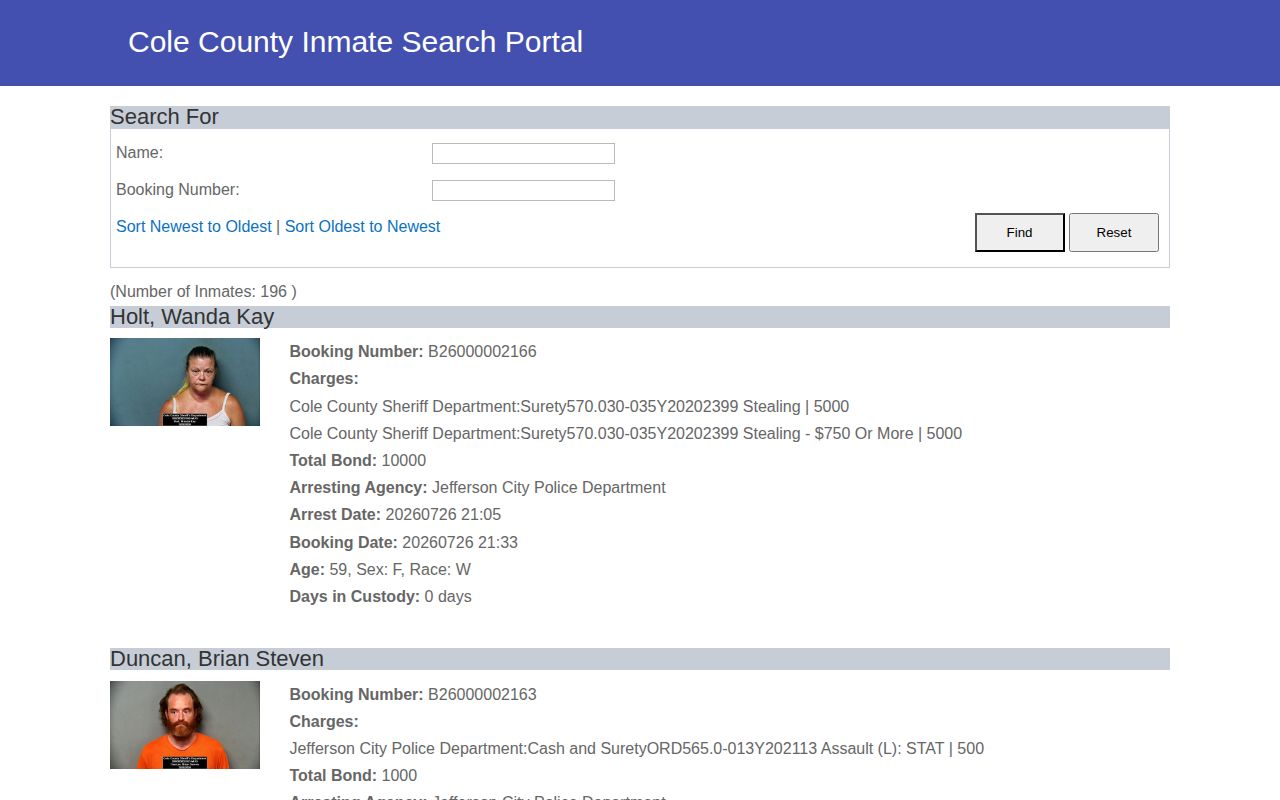
The absence of a release-date filter is material. Booking-date order helps locate a booking, not a release by date. No verified official 24-hour or 72-hour released view, public archive, update cadence, or post-removal retention statement was found.
MODOC Cole County Release Search
The Missouri Department of Corrections Offender Web Search covers active offenders, including people in prison and under probation or parole. It expressly excludes discharged offenders. Search by DOC number when possible because names and aliases can create false matches. Record the exact status, facility or supervision assignment, sentence and case information, and every date with its original label.
| Search clue | How to use it |
|---|---|
| DOC number | Preferred identifier for matching a MODOC record |
| Name fields | Compare identifying details and aliases carefully |
| Status | Distinguish prison, community supervision, and completed authority |
| Location or district | Shows an institution or supervision assignment, subject to update timing |
| Date labels | Preserve minimum, maximum, sentence, parole, or other labels exactly |
A parole or conditional-release status shows that prison confinement ended while MODOC authority continued. Final discharge is different. The nightly MODOC historical offender file is the official fallback for people no longer in the active search and may contain records dating to 1974.
Note: MODOC's active search excludes discharged offenders, so a missing active record does not resolve final discharge history.
Cole County Court Release Search
Cole County is in the 19th Judicial Circuit. Missouri Case.net keeps the judicial trail after a person drops from the jail roster. Search by case number when possible, or narrow a name search with court and case facts. Read docket entries around bond, warrants, release orders, dismissal, judgment, sentence, probation, commitment, and closure.
The official Case.net entry and search route is the durable court channel:
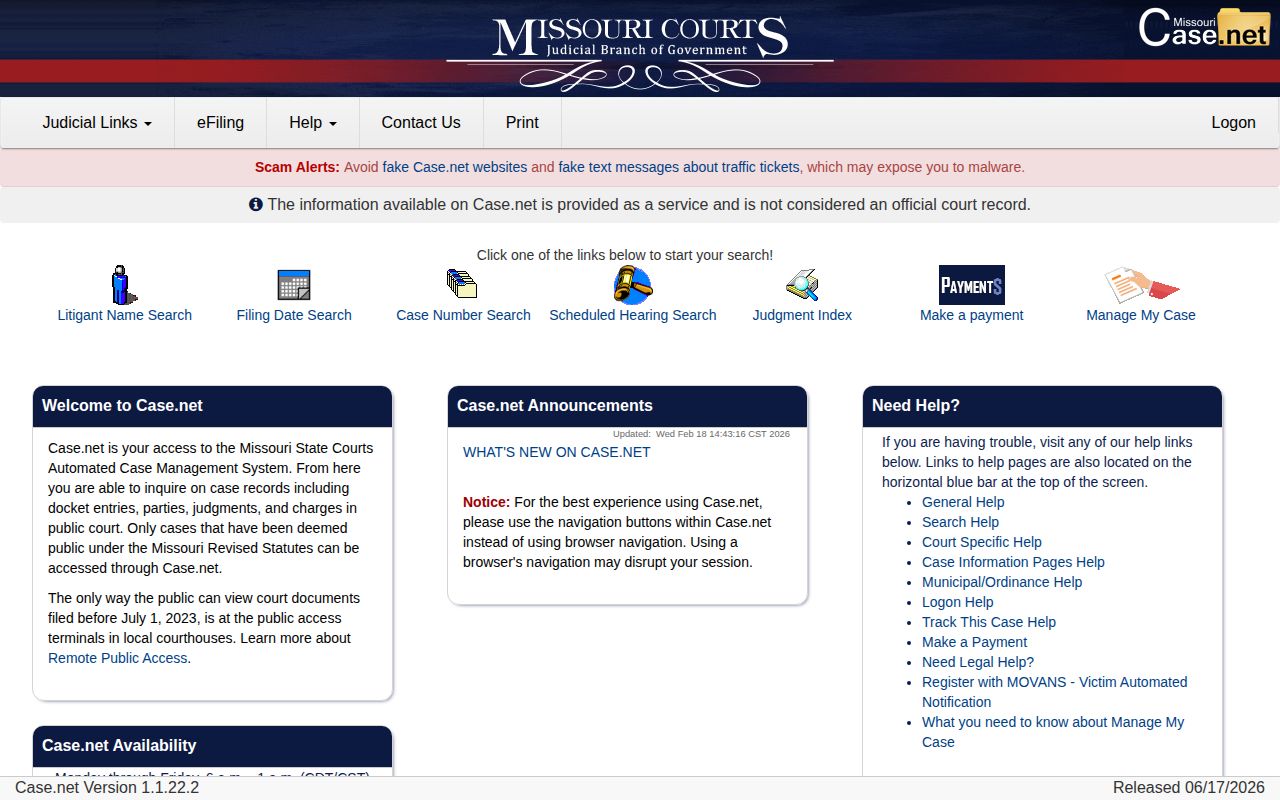
A court order shows legal authority but may not establish physical exit if another hold exists. Put the case number and order date into the county records request. The Circuit Court is at 301 East High Street, Jefferson City, MO 65101, and its main number is 573-634-9150.
Cole County Post-Release Supervision
Probation, parole, and conditional release are separate statuses. Probation is imposed by a court. Parole is ordered by the Missouri Parole Board after prison. Conditional release is a statutory part of some MODOC sentences. All can place a person in the community under conditions without final discharge.
Cole County's ordinary field office is District 27 at 3411B Knipp Drive, Jefferson City, MO 65109, 573-751-4949. Older official material lists a West Main address, so call before visiting. The active MODOC search can show a current supervisee. The broader verification sequence, including office routing and discharge evidence, appears on the Cole County parole and probation page.
Cole County Prison Release Reentry
MODOC Reentry Services is based at 1717 Industrial Drive in Jefferson City. It coordinates reentry centers within state prisons and community follow-up. That route serves a Missouri prison transition, including releases connected to Algoa or Jefferson City Correctional Center. It is not the ordinary destination for a person who posts bond at the county jail.
Use the custody source to avoid misrouting. A MODOC number and state status point to the state reentry and supervision system. A Cole County booking number with a bond or county court order points first to the jail and 19th Circuit records. These streams can overlap, but they are not interchangeable.
Note: State reentry services address Missouri prison transitions and should not be presented as the standard Cole County bond-release route.
Cole County Release Notification Channels
MODOC calls its state-corrections notification system MOVANS. It can provide custody location, parole-hearing dates, scheduled release dates, and notice when a Board decision enters the system for a person in department custody. VINELink is the public VINE interface. Cole County's participation must be checked in the live agency selector before assuming that VINELink covers a county booking.
The Sheriff's official page separately confirms MobilePatrol detention-center and victim-notification information. Neither channel is a certified gate log. Data can lag, and a transfer alert is not a community-release alert. The Missouri State Highway Patrol registry is relevant only to people with a statutory registration duty; it is not a general list of Cole County released inmates.
Cole County Federal Transfer Records
Cole County's federal-local crossover is unusually visible. A 2025 county procurement reported an average of 38 federal inmates. The roster can show federal-agency or U.S. Marshals Service holds, and the handbook contains USMS-specific property-transfer rules. The county jail is still not a federal prison. Removal from its roster can mean federal pickup rather than return to the community.
The BOP locator covers current federal inmates and many people released after 1982. A past release date or “RELEASED” location ends only BOP custody; supervised release, state custody, or immigration custody may continue. A USMS pretrial detainee may not have a BOP locator record. ICE offers A-number and biographical search routes, but a missing result is not proof of release. Request the county transfer entry first, then confirm with the named receiving authority.
Note: A federal locator result answers only that agency's custody question and does not establish a Cole County community release.
Cole County Custody Record Comparison
The right source depends on both the former custodian and the event being proved. Update timing can affect every online system, so imminent release requires direct agency confirmation.
| System | Best use | Key limit |
|---|---|---|
| Cole County portal | Current county booking and booking number | No verified release field or archive |
| Jail release record | Actual county custody end and transfer code | Must be requested after portal removal |
| Case.net | Bond, order, judgment, and sentence | May not show the physical exit time |
| MODOC active search | State prison or ongoing supervision | Excludes discharged offenders |
| MODOC historical file | Completed state authority and historical data | Nightly data is not a same-day gate log |
| BOP, ICE, or USMS route | Federal or immigration movement | Each proves only its own custody relationship |
Cole County Release Facilities
Four facilities require distinct record paths. The Cole County Detention Center release record covers the adult county jail and may show community release or transfer. Algoa Correctional Center and Jefferson City Correctional Center are active MODOC prisons; use state offender, supervision, and discharge records. Michael Prenger Family Center operates a small secure juvenile unit, where confidentiality is the starting point and authorized parties must use the juvenile court.
- Cole County Detention Center: county jail record plus court or receiving-agency confirmation.
- Algoa Correctional Center: MODOC active search, historical file, and state records request.
- Jefferson City Correctional Center: MODOC status and institutional or District 27 routing.
- Michael Prenger Family Center: juvenile court confirmation subject to statutory limits.
The former Missouri State Penitentiary is a historic site, not a current release source.
Note: A Jefferson City address alone cannot distinguish county jail custody, state prison custody, supervision, or juvenile detention.