
Confirm Jefferson City Correctional Center Release
Begin with the event being tested. Release to parole or conditional release ends prison confinement while the sentence and MODOC authority continue. Transfer ends JCCC custody but starts or continues custody elsewhere. Final discharge ends the department's authority. The same person can pass through all three stages on different dates, so one broad “release date” can conceal the part that matters.
The active offender record is strongest for current MODOC status. An institutional movement record identifies transfer. A field office can route questions after community release. The historical file and a formal MODOC response cover the gap after final discharge. Court records support the sentence and any amended judgment, but they do not replace the department's actual movement or prison-exit event.
Search Jefferson City Correctional Center Status
Use the MODOC Offender Web Search, never the Cole County current roster. The state search includes active offenders in prison and under community supervision. It states that discharged offenders are excluded. A MODOC number is the best key because it can connect the sentence, facility, parole, and historical rows across name variants.
- Enter the MODOC number, or use the permitted name fields when it is unknown.
- Compare identifiers and case details before selecting the person.
- Copy the exact status, institution or supervision location, and date labels.
- Check whether the record indicates confinement, community supervision, or another placement.
- For a missing discharged record, move to the historical data and Sunshine route.
- Confirm a contested event through the institutional movement, release, or discharge record.
The official MODOC active-search source below shows the correct statewide route.
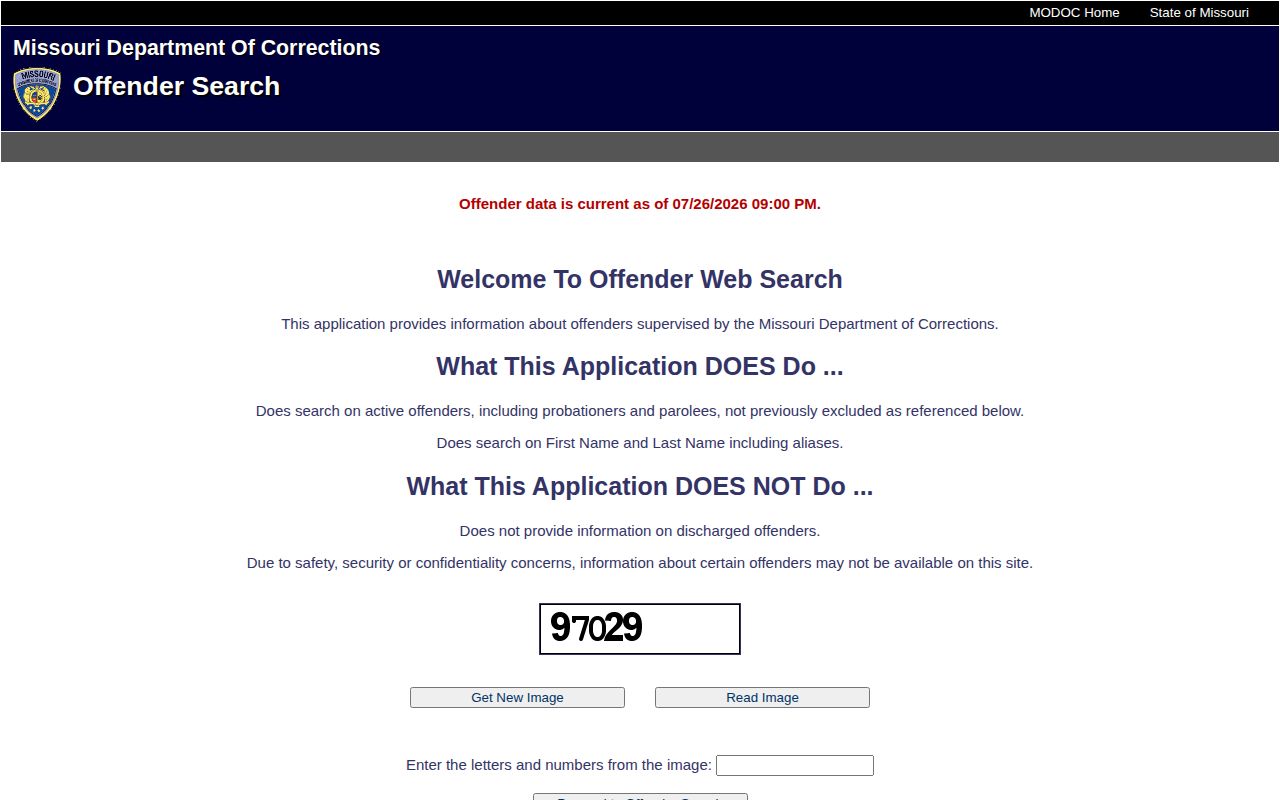
The public result is not a live JCCC gate log and can lag a same-day change.
Jefferson City Correctional Center Discharge Records
A useful request identifies the offender, MODOC number, approximate period, and exact existing records sought. Ask for the prison release or transfer event, event type, receiving institution or agency if disclosable, supervision start, supervision end, and final discharge certificate or order. If a sentence calculation is disputed, include the relevant minimum, maximum, completion, credit, and court-case fields.
MODOC's Sunshine Law Offender Data page provides the historical file and divisional request routes. OD.SunshineRequest@doc.mo.gov is listed for Office of Director matters, while ParoleBoard.SunshineRequest@doc.mo.gov serves Board records. The historical file updates nightly and includes people who are or have been under department supervision. It can reach records as early as 1974.
The official MODOC historical-data source is shown below.
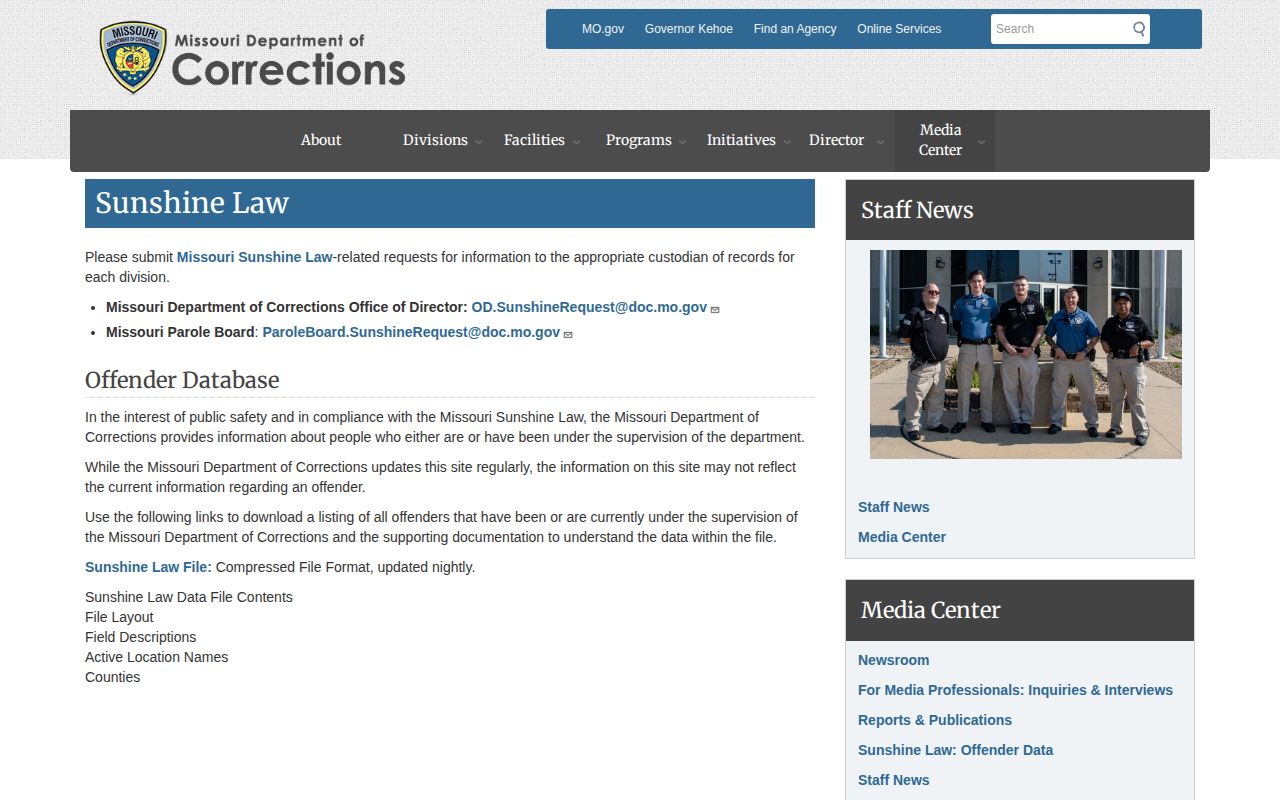
This source is essential after final discharge because the live search says it excludes discharged offenders.
Jefferson City Correctional Center Records Contact
Jefferson City Correctional Center is located at 8200 No More Victims Road, Jefferson City, Missouri 65101. Its published phone number is 573-751-3224. The institution can route a current facility question and explain which office handles an allowed inquiry. A durable record request should go through MODOC's established Sunshine channel rather than relying on an informal phone response.
Jefferson City Correctional Center8200 No More Victims Road
Jefferson City, MO 65101
573-751-3224
Use the institutional parole office for release-plan questions before a prison exit. Once the person is on community supervision, the assigned field district is the more direct source. District 27-Jefferson City is the ordinary Cole County field office at 3411B Knipp Drive, 573-751-4949, though the offender record may point elsewhere.
Note: Call first because staff roles, assigned offices, and what may be disclosed can differ with the person's current status.
Jefferson City Correctional Center Release Types
Each type of exit calls for a different conclusion. A parole record shows Board-ordered community release before the sentence expires. Conditional release is a statutory sentence term served in the community. An inter-institution transfer means another MODOC site holds the person. A transfer to an outside agency should be paired with that receiving agency's intake. Final discharge marks the end of state authority.
| JCCC event | Where the person goes | Confirmation |
|---|---|---|
| Parole | Approved community plan | Active MODOC status, Board and field office |
| Conditional release | Community supervision | MODOC sentence and supervision records |
| MODOC transfer | Another state institution | Department location and movement record |
| Outside transfer | Another custodian | JCCC movement plus receiving-agency intake |
| Final discharge | No remaining MODOC authority | Historical file or discharge document |
These categories prevent the common error of calling any removal from the institution a release to the street. The Cole County custody and release search provides the wider records chain when another agency receives the person.
Jefferson City Correctional Center Release Dates
The MODOC historical dictionary names “Sentence-I Minimum Release Date” and “Sentence Maximum Release Date.” The first is a calculated minimum on an active sentence. The second is the sentence maximum release or expiration date. The file also includes completion, sentencing, sentence length, court, case, county, offense, and probation fields. One row per charge means several rows may need reconciliation.
A minimum date is not an appointment to leave JCCC. Missouri minimum-prison-term law, conditional-release terms, Board action, consecutive sentences, amended judgments, discipline, detainers, program or risk review, and revocation can affect the practical path. Report the source's exact label and then confirm the actual event. The live search's post-CAPTCHA date labels were not verified, so they must not be guessed.
- Minimum date
- A calculated eligibility point on an active sentence.
- Maximum date
- The recorded sentence maximum release or expiration field.
- Parole
- Release from prison while MODOC legal custody continues.
- Final discharge
- The end of department authority after all governing terms are met.
Note: Several charge rows may govern one offender, so no single minimum or maximum field should be read in isolation.
Jefferson City Correctional Center Release History
The official JCCC family page describes a 130-acre complex with nineteen buildings and eight residential units. JCCC opened in September 2004. It is the active maximum and medium-security institution at this location. It is not the former Missouri State Penitentiary, which is now a historic site rather than an operating release source.
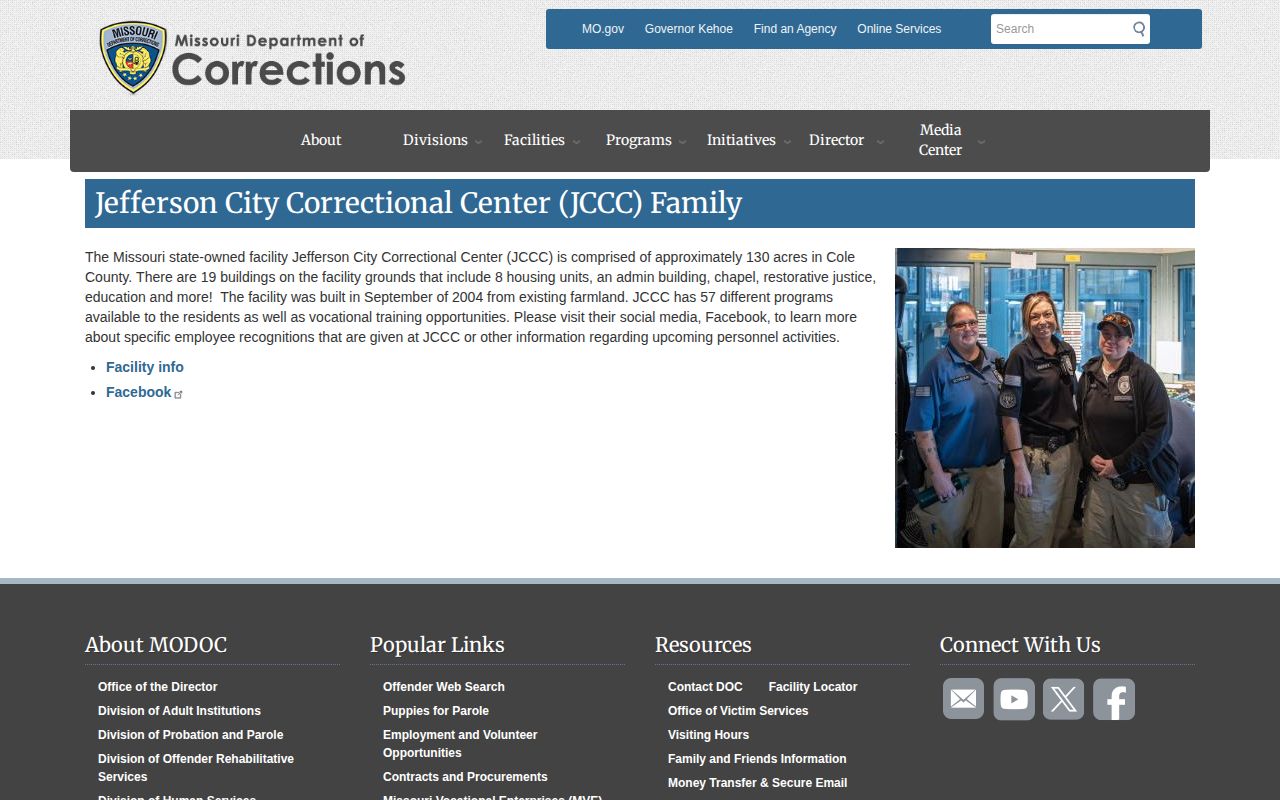
The history helps sort ambiguous Jefferson City searches. The city also contains Algoa Correctional Center, the Cole County Detention Center, state supervision offices, and MODOC administration. A Jefferson City address alone cannot identify the custody system. The exact facility name and MODOC number should anchor the search.
JCCC Parole Release Office Routing
Before release, the institutional parole function works with case staff on planning. Specific home-plan or institutional release questions belong there. The Missouri Parole Board controls parole decisions, and its guidelines do not guarantee release. A hearing may result in a later release date or another hearing. The Board's decision timing and the physical exit must be kept separate.
After prison exit to parole or conditional release, the assigned field office verifies community supervision. District 27 is the ordinary Cole County office, but a person can be placed in another district. Read the live MODOC location or office label and call the published office. When supervision ends, use the historical or discharge record because the active search is not intended to retain final discharges.
A notification from MOVANS or VINELink can flag a hearing, decision, or custody event. It is not the institutional release record. Confirm the notice with MODOC and distinguish release to community supervision from final discharge.
JCCC Release Search Mistakes
The Cole County inmate portal should not be used for JCCC. It is a county-jail roster with local booking numbers, charges, bonds, and arrest dates. It does not carry the MODOC sentence, state facility assignment, parole status, or final discharge. A person may have an old county booking and a later JCCC sentence, but those are distinct records joined through the court case and state identifier.
Another mistake is reading location loss as freedom. Movement to another MODOC institution, an outside detainer pickup, or a hospital placement can end JCCC display without community release. A third mistake is treating a Board decision as discharge. Parole continues legal custody in the community. Only the relevant movement, supervision, and discharge records resolve the sequence.
Note: When records conflict, the direct JCCC movement event and the receiving system's intake normally outweigh a projected date or general alert.